

Global take on consumer products news
Provided by AGP
MOPE Clinic Emphasizes Comprehensive Labs Before Testosterone Therapy
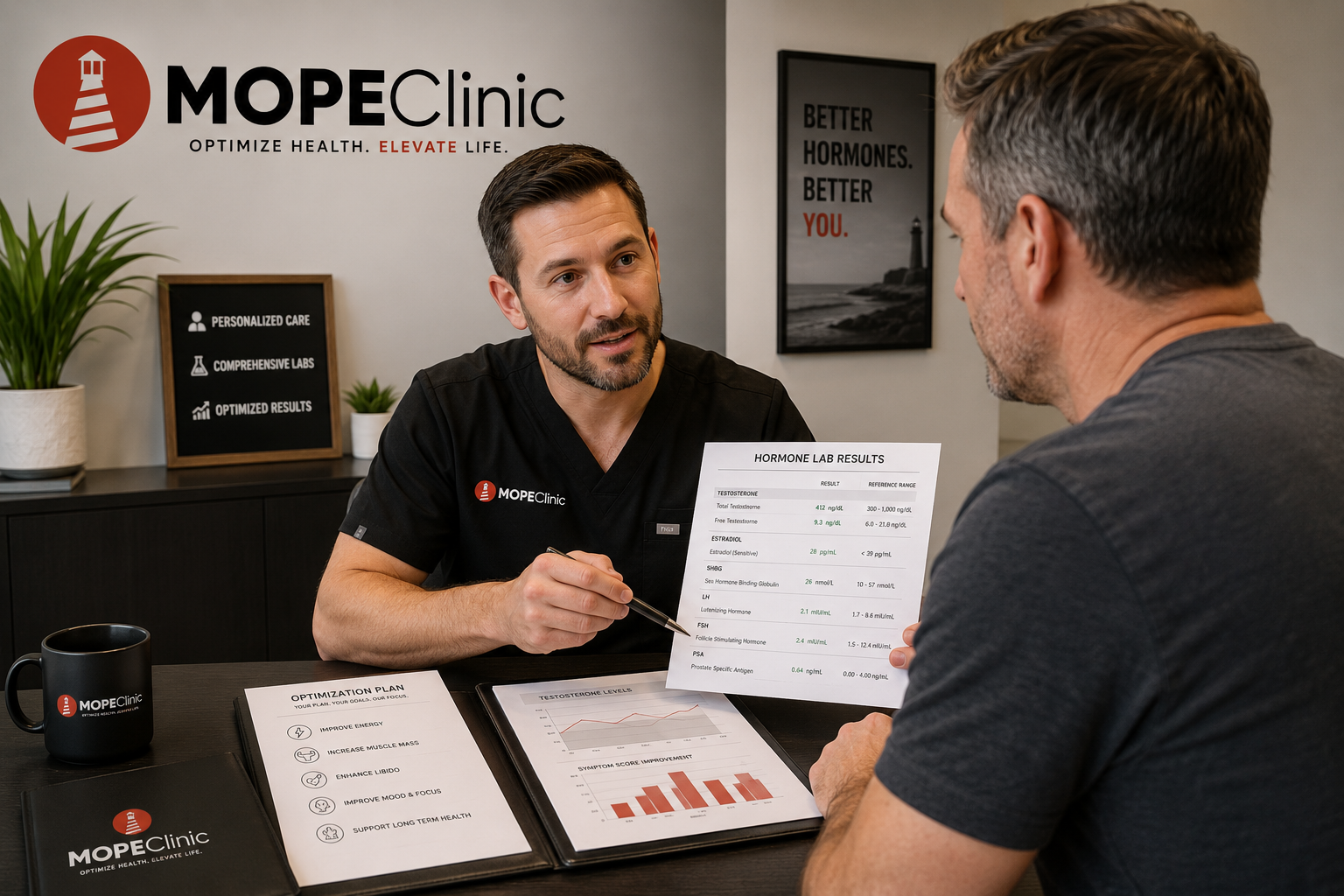
MOPE Clinic provider reviewing testosterone lab results with a patient in Metairie, LA
LegitScript-certified Louisiana clinic emphasizes comprehensive diagnostic evaluation, patient education, and ongoing monitoring as standard of care.
This is standard practice in academic medicine. In commercial telemedicine, it's rare. Most providers want to prescribe quickly and move on. Real medicine requires real follow-up”
— Chris Rue, APRN, FNP-C, MOPE Clinic Owner
METAIRIE, LA, UNITED STATES, May 16, 2026 /EINPresswire.com/ -- MOPE Clinic, a LegitScript-certified medical practice serving South Louisiana, today released a comprehensive clinical framework addressing how men should approach low testosterone treatment decisions—emphasizing comprehensive diagnostic evaluation, patient education on treatment mechanisms, and individualized care planning before any prescription.
The framework responds to a widespread clinical problem: men make lifelong health decisions affecting fertility, cardiovascular health, and long-term quality of life based on incomplete laboratory work, one-sided provider recommendations, and insufficient understanding of their treatment options.
THE PROBLEM: WHY STANDARD PRACTICE FALLS SHORT
Most men receiving testosterone treatment do so after minimal laboratory evaluation. Standard telemedicine clinics perform only a total testosterone test—a critical diagnostic gap that prevents proper clinical reasoning.
"A total testosterone level tells you roughly how much hormone is in the bloodstream, but it doesn't tell you why it's low, whether your body can still produce it, or which treatment approach will actually work for your specific physiology," explained the MOPE Clinic clinical team.
A complete hormone panel requires multiple markers: total and free testosterone, sex hormone-binding globulin (SHBG), luteinizing hormone (LH), follicle-stimulating hormone (FSH), estradiol, prolactin, and metabolic indicators like lipids and hematocrit.
Without these markers, clinicians cannot distinguish between primary hypogonadism (testicles don't function well) and secondary hypogonadism (brain-to-testicle signaling is disrupted)—a distinction that fundamentally determines which treatment approach is appropriate.
Additionally, men often receive one-sided recommendations from providers trained in a single treatment methodology. Most patient-facing materials never explain the fundamental differences between treatment approaches, how they work biologically, or what tradeoffs exist between speed of results, long-term sustainability, fertility preservation, and monitoring requirements.
THE CLINICAL STANDARD: WHAT COMPREHENSIVE EVALUATION REVEALS
Different testosterone treatment approaches operate through fundamentally different mechanisms with significantly different implications for fertility, long-term dependency, testicular health, and treatment reversibility.
Some approaches preserve natural testosterone production by signaling the body to produce more hormone—maintaining testicular function, sperm production, and treatment reversibility. Others add external testosterone directly, which suppresses natural production, causes testicular atrophy, and creates long-term dependency.
These are not minor differences. They determine whether a 35-year-old man planning a family receives a reversible treatment versus one affecting his fertility. They determine whether a man remains dependent on medication for life or potentially discontinues treatment.
"Men deserve to understand these distinctions," the clinical team explained. "They also deserve to know what they're giving up by choosing one path over another. Most don't receive that education."
CLINICAL DECISION FRAMEWORK: KEY FACTORS
Proper treatment selection requires evaluating multiple factors:
**Fertility Status.** Is the patient concerned about future family planning? Different treatment approaches have dramatically different implications for sperm production and fertility preservation. A reversible approach that maintains testicular function is fundamentally different from one causing permanent testicular changes.
**Age and Testicular Reserve.** Younger men with adequate testicular reserve may have different options than older men. Treatment selection depends partly on whether the testicles can respond to hormonal signaling or have simply failed.
**Root Cause of Low Testosterone.** Is the problem testicles that don't function (primary hypogonadism) or disrupted signaling from the brain (secondary hypogonadism)? These require different approaches. Secondary hypogonadism caused by obesity, stress, or sleep deprivation may respond to approaches targeting signaling differently than primary testicular failure.
**Speed vs. Predictability.** Some approaches work quickly but with variable response. Others take longer but produce highly predictable results. Patient priorities matter—someone with severe symptoms may prioritize speed; someone with fertility concerns may prioritize reversibility.
**Long-Term Commitment and Dependency.** Some treatment approaches allow discontinuation or intermittent use. Others require lifelong treatment. This is not a clinical question—it's a patient preference question that deserves honest discussion.
**Monitoring Complexity.** Different approaches require different monitoring protocols. Some require simple, straightforward lab rechecking. Others require complex monitoring of multiple hormonal markers. Patient preferences and access to care matter.
WHY SOUTH LOUISIANA CONTEXT MATTERS
South Louisiana's climate, lifestyle, stress patterns, and regional diet create unique metabolic conditions that influence testosterone baseline and treatment response—differently than national clinical studies suggest.
Heat and humidity create chronic dehydration stress, elevating cortisol and impairing testosterone production. The regional diet—rich, sodium-heavy, calorie-dense—influences baseline metabolic health and lipid profiles. High-pressure work environments and regional lifestyle patterns elevate cortisol chronically. These factors affect how the body handles any testosterone treatment and should influence baseline assessment and dosing decisions.
"A 'standard dose' prescribed in Chicago doesn't work the same in New Orleans," the MOPE Clinic team explained. "We account for South Louisiana context in every baseline lab panel—actual metabolic health, stress markers, hematocrit, lipid profile, and individual testosterone baseline. Then we choose treatment approach and dosing accordingly."
WHAT MOPE CLINIC DOES DIFFERENTLY
MOPE Clinic follows the clinical standard of care that most providers skip:
Step 1: Comprehensive Baseline Labs. Before any prescription, patients receive a full hormone panel plus metabolic assessment, revealing which hormonal pathway is disrupted and what baseline metabolic factors may be contributing. This takes time and costs more upfront—but it's the foundation for proper clinical reasoning.
Step 2: Education and Mechanistic Comparison. Patients understand how different treatment approaches work biologically, which aligns with their fertility plans, lifestyle, and health history—with no sales pitch or pressure to choose a particular option. Informed consent requires informed patients.
Step 3: Personalized Clinical Recommendation. Based on labs, health history, fertility goals, age, and lifestyle, MOPE Clinic outlines which treatment approach is recommended and why, with full transparency on alternatives and tradeoffs. The recommendation is documented and reasoned, not intuitive or one-sided.
Step 4: Ongoing Monitoring and Optimization. Labs are rechecked at 6 weeks, 12 weeks, 6 months, and annually. Doses are adjusted based on response. Side effects are caught early and managed. Treatment doesn't end with a prescription.
"This is standard practice in academic medicine," the team noted. "In commercial telemedicine, it's rare. Most providers want to prescribe quickly and move on. Real medicine requires real follow-up."
MONITORING STANDARDS: WHY LABS MATTER
Different treatment approaches require different monitoring protocols and timelines. Some require labs at 6 weeks to assess early response; others at 4–6 weeks. Some require simple testing; others require complex hormone panel tracking.
The point: proper monitoring prevents side effects, optimizes dosing, and catches treatment failures early. Men deserve clear communication about what monitoring will look like, why it matters, and what adjustments may be needed as treatment progresses.
Without proper monitoring, men start treatment, expect results in 2–4 weeks, and abandon approaches before hormonal changes take full effect. Dosing is never optimized. Side effects go undetected. Treatment failures are attributed to the drug rather than the protocol or the patient's individual response.
SIDE EFFECTS: WHAT TO EXPECT AND HOW THEY'RE MANAGED
Different testosterone treatment approaches carry different side effect profiles. Some approaches raise cardiovascular risk factors like blood pressure and lipid changes. Others may cause estrogen-related side effects like gynecomastia or water retention.
All of these are manageable when monitored. Most serious side effects are preventable with proper baseline assessment, appropriate dosing, and ongoing monitoring.
"The question isn't whether a treatment has side effects—all medications do," the team explained. "The question is whether you're monitoring for them and managing them appropriately. That's the difference between real medicine and telemedicine."
FREQUENTLY ASKED QUESTIONS
Q: Why do I need so many baseline labs?
A: Because different lab values tell different stories. Total testosterone alone misses critical information about whether your testicles work, whether your brain is signaling properly, and whether other factors (like high SHBG or elevated estradiol) are affecting your hormone availability. Full labs reveal what's actually going on.
Q: How long before I feel results?
A: It depends on which treatment approach is selected and your individual response. Some approaches produce results in 2–4 weeks for mood and energy. Others take 4–12 weeks. Muscle gain typically takes 8–12 weeks regardless of approach. Individual variation is significant.
Q: What if treatment doesn't work?
A: You have several options: adjust the dose, extend the trial period (some men respond slowly), address underlying factors like obesity or poor sleep, or switch to a different treatment approach. This is why starting with full labs and expert guidance matters—you'll have clear data about whether it's working and what to do next.
Q: Can I stop treatment once I start?
A: It depends on the treatment approach selected. Some approaches allow discontinuation or intermittent use with recovery of natural production. Others create long-term dependency. This distinction should be discussed before treatment starts so you understand the long-term commitment you're making.
Q: Do I need additional medications to manage side effects?
A: It depends on your individual response and which side effects emerge. Labs determine this; it's not automatically prescribed. Some men need adjunctive medications; most don't, especially if the initial approach and dosing are appropriate.
Q: What about supplements instead of prescription treatment?
A: If testosterone is clinically low and causing symptoms, supplements are not medicine. Proper treatment requires proper diagnosis, proper prescribing, and proper monitoring by a real doctor.
Q: How often will I need lab work?
A: Initially at 6 weeks, then 12 weeks, then 6 months, then annually. More frequent testing may be needed if dose adjustments are made or side effects emerge. Ongoing monitoring is part of the treatment plan, not optional.
ABOUT MOPE CLINIC
MOPE Clinic is a LegitScript-certified medical practice located in Metairie, Louisiana, serving Metairie, New Orleans, Mandeville, Covington, Slidell, Houma, and throughout South Louisiana. The clinic specializes in evidence-based hormone optimization and personalized medicine, with a clinical focus on comprehensive diagnostic evaluation before any treatment, transparent patient education on treatment mechanisms and tradeoffs, individualized treatment planning, and ongoing clinical monitoring.
MOPE Clinic is not a virtual-only provider. All patients receive in-person consultations, clinical laboratory work, and ongoing physician monitoring. Every patient receives a personalized treatment plan based on their labs, goals, and health status—not cookie-cutter care.
CONTACT
MOPE Clinic
504-322-3888
mopeclinic.com
Metairie, Louisiana
Gwen M.
Designs For You
email us here
Visit us on social media:
Facebook
Legal Disclaimer:
EIN Presswire provides this news content "as is" without warranty of any kind. We do not accept any responsibility or liability for the accuracy, content, images, videos, licenses, completeness, legality, or reliability of the information contained in this article. If you have any complaints or copyright issues related to this article, kindly contact the author above.
