

Skewed sex ratios may be rewriting toad courtship
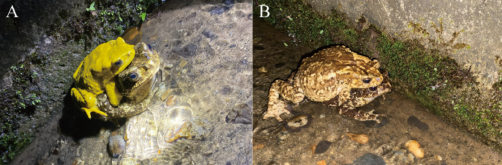
The amplexus of Duttaphrynus cyphosus. A: Male-female amplexus; B: Female-female amplexus.
FAYETTEVILLE, GA, UNITED STATES, April 23, 2026 /EINPresswire.com/ -- In animal breeding, unusual behavior can reveal hidden pressure in the environment. A new study reports a rare case of female-female amplexus in the toad Duttaphrynus cyphosus, offering a closer look at how disrupted mating conditions may shape reproductive behavior. Across five years of field observations, researchers found that this non-typical clasping behavior was uncommon, yet it appeared only when breeding groups became strongly female-biased. The finding adds an ecological dimension to amphibian behavior studies, suggesting that extreme shifts in sex balance may be linked to unexpected reproductive interactions in the wild.
Amplexus, the mating clasp used by many amphibians, usually involves a male grasping a female to enable external fertilization. Although mismatched or same-sex amplexus has been documented in some amphibians, female-female amplexus remains especially rare and poorly understood. Such behavior does not normally lead to successful reproduction, but it may point to stress, confusion in mate recognition, or intense competition when mates are scarce. In wild populations, breeding behavior can also be shaped by local ecological disturbance and human interference. Based on these challenges, deeper research is needed on how demographic imbalance influences reproductive behavior in amphibians.
Researchers from Anhui University in China, with a collaborator from the University of Queensland, reported (DOI: 10.3724/ahr.2095-0357.2025.0061) the findings in Asian Herpetological Research. The paper was published online on February 27, 2026. Focusing on breeding populations of Duttaphrynus cyphosus in Chayu County, Xizang Autonomous Region, the team documented a rare female-female amplexus pattern and examined whether extreme female-skewed operational sex ratios may help explain why such behavior appeared during the breeding season.
The researchers monitored the species over five breeding seasons and recorded 668 amplexus events in total. Only four involved one female clasping another, making the phenomenon rare, at roughly 0.6% of all observed events. In one striking case, a gravid female released eggs while being clasped by another female. All four events occurred during the later part of the breeding season, when the operational sex ratio rose to an extreme 15–20 females per male. The study notes that local capture of males for food and sale may have contributed to this imbalance. The team does not claim direct causation, but the pattern is hard to ignore. They also discuss several possible explanations: mistaken mating attempts under mate scarcity, competition between females, mechanically triggered egg release, or confusion caused by ambiguous body coloration. At the same time, the authors remain cautious, noting that they found no direct evidence that any eggs released during female-female amplexus were fertilized.
“This study suggests that even a brief and unusual breeding event can carry a much larger ecological message,” the researchers argue in effect. “When the social structure of a breeding population becomes severely unbalanced, behaviors that are normally rare may emerge at the edge of reproductive decision-making. Observations like these do not simply add a curiosity to amphibian natural history—they may help reveal how human disturbance, mate scarcity, and recognition errors interact in the wild.”
The implications reach beyond one toad species. Amphibians are already widely used as indicators of environmental change, and this study shows that reproductive behavior may also serve as an early warning signal of demographic stress. For field ecologists and conservation biologists, the work highlights the value of tracking operational sex ratios, breeding-site disturbance, and human harvesting pressure together rather than in isolation. It also encourages closer attention to behaviors once dismissed as accidental. In a changing world, rare events like these may help scientists detect how fragile breeding systems respond before population decline becomes obvious.
References
DOI
10.3724/ahr.2095-0357.2025.0061
Original Source URL
https://doi.org/10.3724/ahr.2095-0357.2025.0061
Funding Information
This work was supported by the National Natural Science Foundation of China (Grant Nos. 32571739, 32270457, 31872216, and 31670392). In addition, this study received approval from the Experimental Animal Ethics and Management Committee of Anhui University (IACUC(AHU)-2024-050).
Lucy Wang
BioDesign Research
email us here
Legal Disclaimer:
EIN Presswire provides this news content "as is" without warranty of any kind. We do not accept any responsibility or liability for the accuracy, content, images, videos, licenses, completeness, legality, or reliability of the information contained in this article. If you have any complaints or copyright issues related to this article, kindly contact the author above.
