

AI Agents Just Got Employee Badges: Developer Launches First Work Platform Where Agents Are Full Users
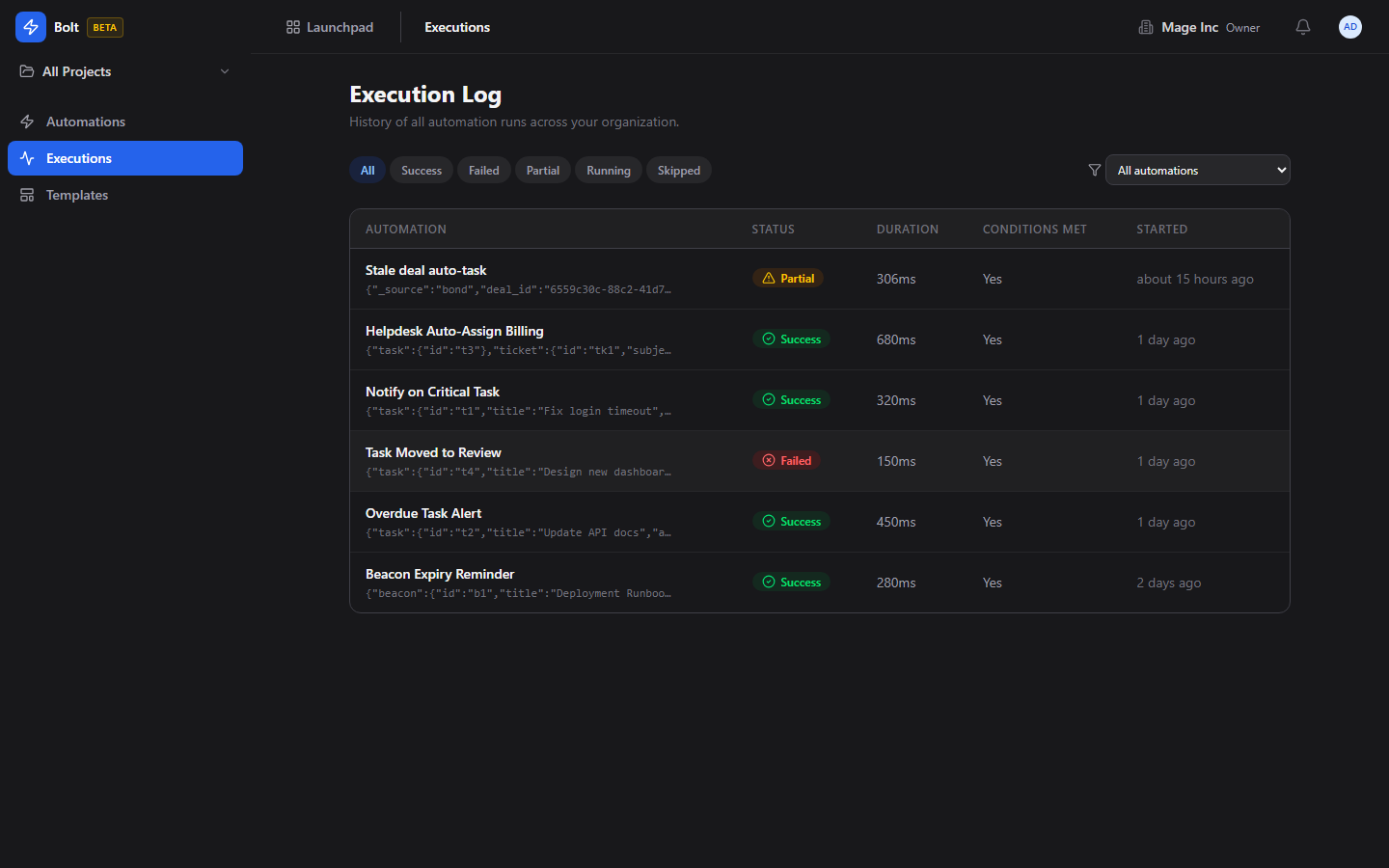
Bolt Executions show a history of Bolt Automations performed by both humans and AI agents
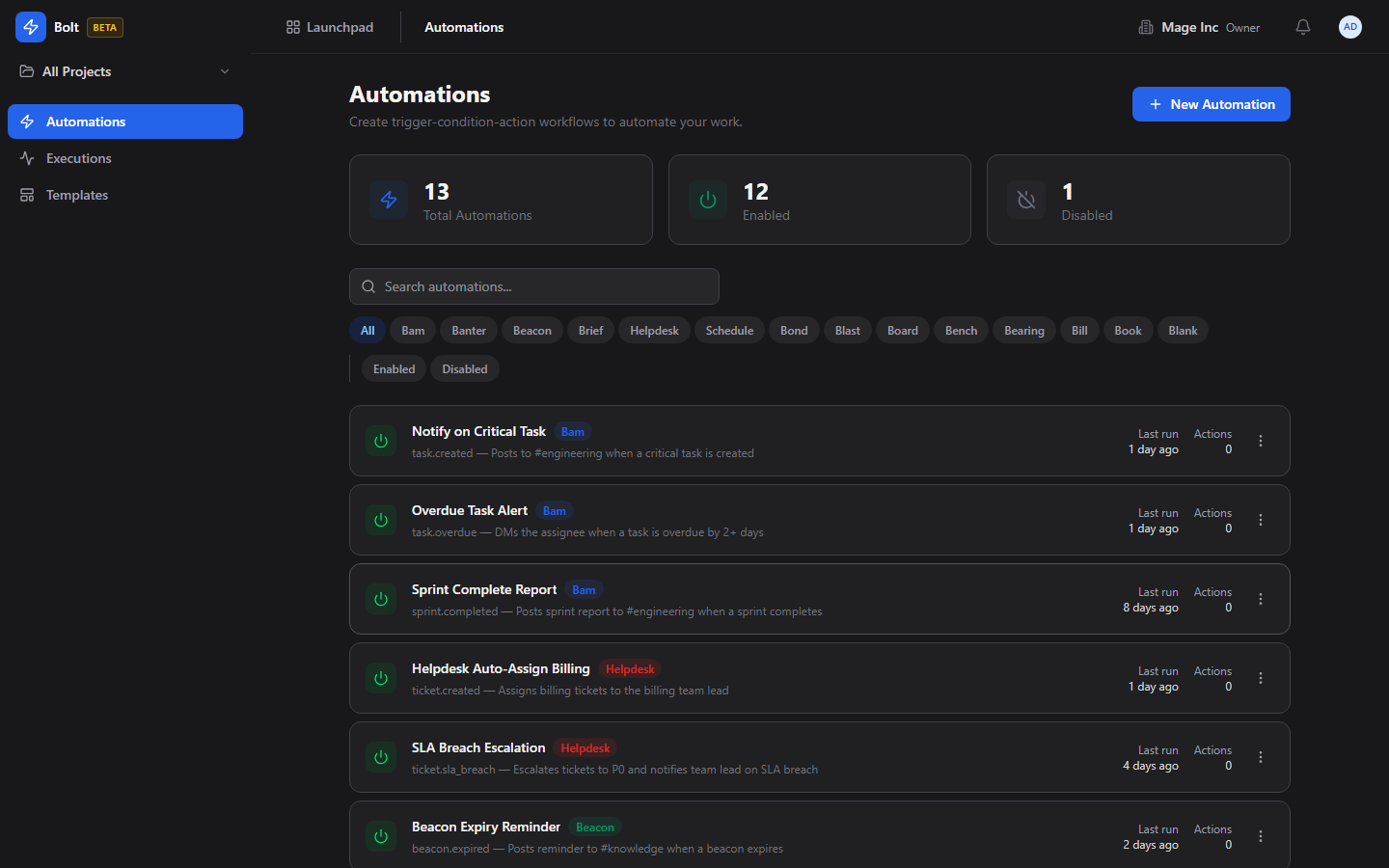
Bolt Automations expose the MCP to humans and AI aline
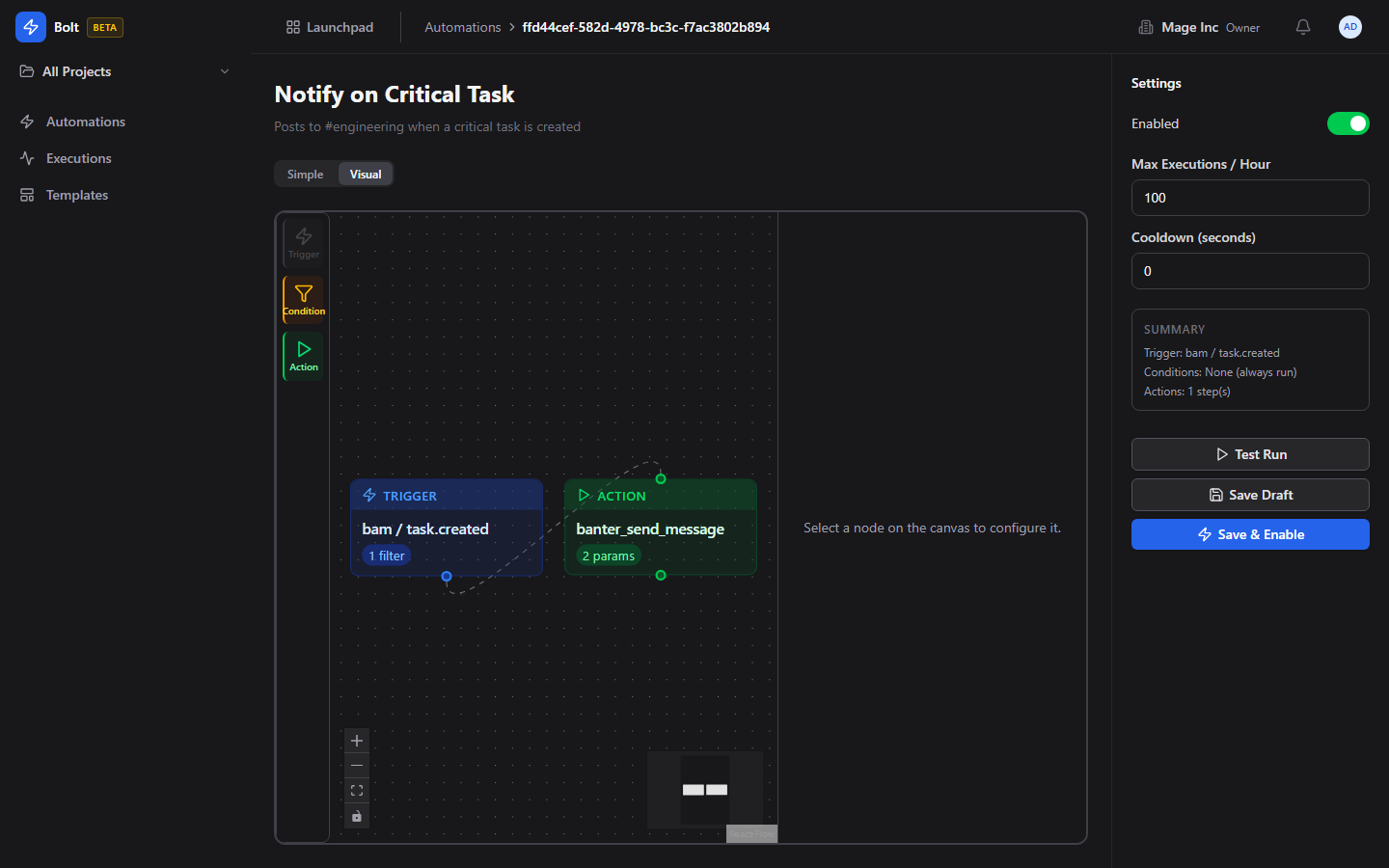
The node graph interface for Bolt
In a structural departure from AI assistant add-ons, new agent architecture gives AI peers the same roles, permissions, and audit trails as human staff.
In BigBlueBam's database, agents are represented by standard "users" records with a single flag (`is_agent = true`) distinguishing them from humans. They hold the same role grants. They appear in the same user directory. They generate the same audit records. And they act through a Model Context Protocol (MCP) server that exposes over 340 tools at the time of writing, every one of which is gated by the same permission system that governs human access.
The design is a direct rejection of the "AI copilot" pattern that has dominated enterprise SaaS product announcements for the past three years.
"Most AI work products give you a chatbot in a sidebar," said Eddie Offermann, the single developer behind BigBlueBam. "That is a cosmetic change. BigBlueBam gives the AI a seat in the org chart. In the database, agents are users. They have roles. They appear in audit logs. When one approves a purchase order, the approval looks identical to a human's, because architecturally, it is."
Why the Architecture Matters
Treating agents as users has several downstream consequences that conventional AI-in-SaaS implementations cannot replicate:
- **Unified accountability.** Every agent action is attributable to a named principal (the agent), scoped by the same permission system humans use, and visible in the same audit log. There is no separate "AI activity" surface to reconcile.
- **Role-appropriate authority.** An agent granted "Project Editor" in Bam could edit tickets but not approve invoices. An agent granted "Finance Approver" in Bill could. The same granularity that applies to human delegation applies to agent delegation.
- **Behavioral configuration separated from authority.** Agents have additional settings (confidence thresholds, rate limits, auto-publish rules, human review triggers) that humans do not need. Those settings live in a separate table. Permissions stay uniform.
- **Natural governance path.** When regulators or auditors ask what the AI did, the answer is a query against the same tables used to answer the question of what any employee did.
The MCP Layer
BigBlueBam ships with a Model Context Protocol server that exposes over 340 tools covering every product in the suite, from creating a project in Bam to sending a Banter message to reading a Beacon knowledge article to generating an invoice in Bill. Agents call those tools through the MCP surface. So does Bolt, the suite's automation engine, which compiles visual workflow rules into chained MCP calls.
That design produces a single, audited execution substrate for both AI agents and human-authored automation.
"Once MCP is the execution layer, the distinction between 'the AI did it' and 'the workflow did it' and 'a human clicked a button' collapses into a single record of what happened, who caused it, and whether they were authorized," Offermann said. "That is what compliance looks like when it has been designed in, not bolted on."
The Governance Question
The architecture surfaces questions that most enterprise AI deployments have not yet had to answer. If an agent approves a fraudulent invoice, who is accountable? BigBlueBam's answer is not a policy argument. It is a schema.
"Corporate governance was written for a world where every action traces to a named human," Offermann said. "The honest way to extend it is to give AI agents the same kind of traceable identity. Not a service account. Not an API key. A real user record, with a role, with a manager, with a performance history. You can govern that. You cannot govern a chatbot."
Availability
BigBlueBam is available in public beta starting now under the MIT license. Source code, deployment documentation, Docker Compose files, and migration tooling are available on GitHub.
Teams with the infrastructure and expertise to self-host are encouraged to do so; the project targets deployments from 2 to 100 people on a single commodity Docker host, with larger installations possible through self-hosted scaling on DigitalOcean, Railway, or on-premises infrastructure.
For teams who would rather not run their own stack, Big Blue Ceiling will roll out managed hosting later this year, along with an Agent Store that simplifies deployment of advanced AI agents into a BigBlueBam workspace. Additional commercial offerings are planned. The core suite will remain MIT-licensed and self-hostable in perpetuity.
About BigBlueBam
BigBlueBam is an open-source, AI-native work operating system comprising 20 interoperating products covering project management, team communication, knowledge management, automation, CRM, HR, and more. The suite is MIT-licensed, self-hostable, and built on a unified PostgreSQL schema with AI agents treated as first-class users. BigBlueBam is a project of Big Blue Ceiling Prototyping & Fabrication, LLC.
Eddie Offermann
Big Blue Ceiling
email us here
Visit us on social media:
LinkedIn
Legal Disclaimer:
EIN Presswire provides this news content "as is" without warranty of any kind. We do not accept any responsibility or liability for the accuracy, content, images, videos, licenses, completeness, legality, or reliability of the information contained in this article. If you have any complaints or copyright issues related to this article, kindly contact the author above.
