

Fermented Mycoprotein Market Forecast 2026–2036: Global Market to Reach USD 766.7 Million by 2036 at 8.5% CAGR
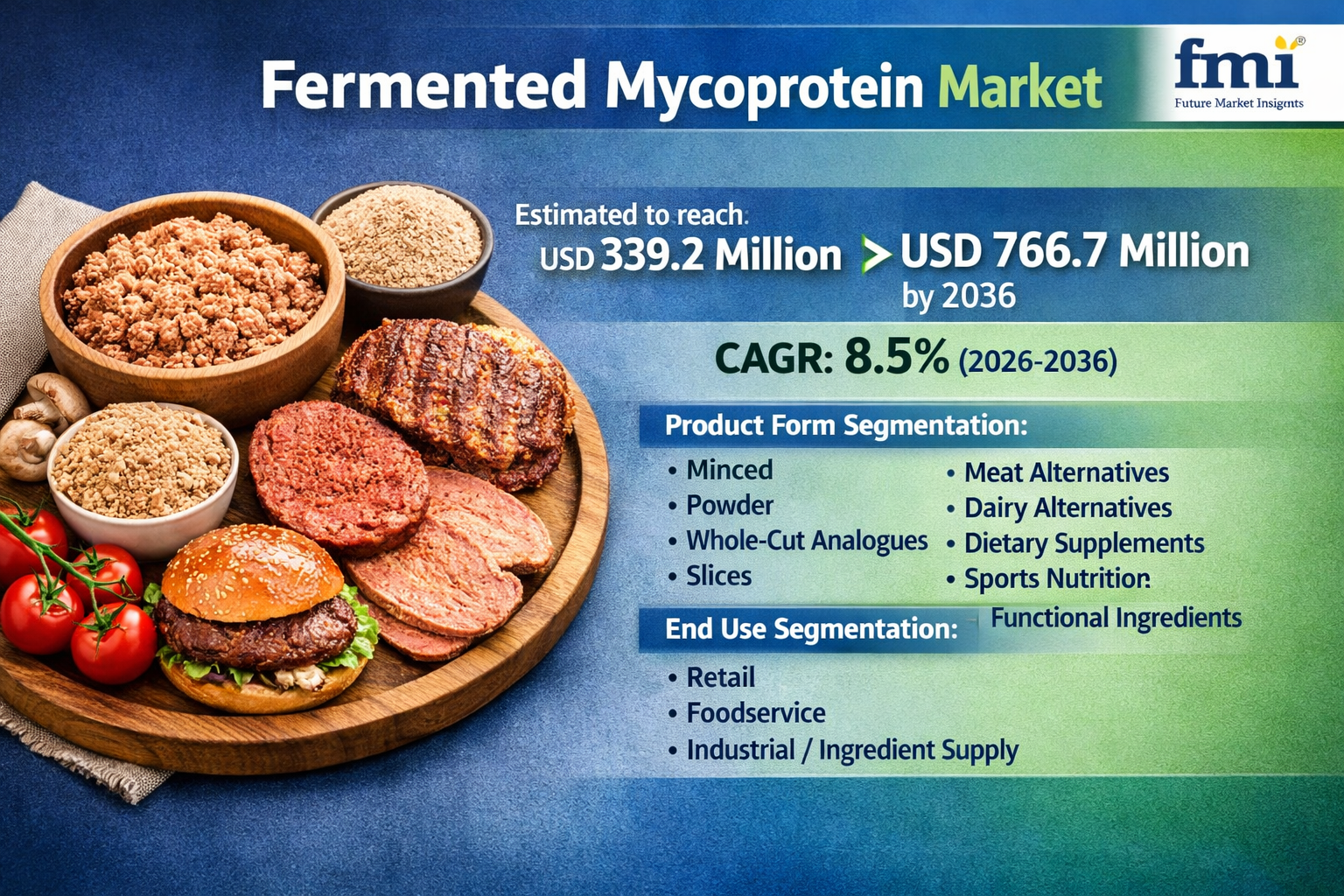
Fermented Mycoprotein Market
Fermented mycoprotein is gaining commercial traction as brands scale production, secure regulatory clarity & expand into mainstream retail & foodservice channel
NEWARK, DE, UNITED STATES, February 26, 2026 /EINPresswire.com/ -- The global fermented mycoprotein market is entering a pivotal scale-up phase as commercial fermentation capacity, regulatory clarity, and hybrid product innovation converge to reshape the alternative protein landscape. According to the latest analysis by Future Market Insights (FMI), the market was valued at USD 312.5 million in 2025 and is projected to reach USD 339.2 million in 2026. Over the forecast period from 2026 to 2036, the market is expected to expand at a CAGR of 8.5%, reaching USD 766.7 million by 2036.
The sector’s expansion reflects a structural shift beyond niche vegetarian consumption toward broader flexitarian adoption. Manufacturers are increasingly embedding fermented fungal protein into hybrid meat formats, functional foods, and B2B ingredient platforms, positioning mycoprotein as a premium, nutritionally complete alternative to commodity plant proteins.
Request For Sample Report | Customize Report | Purchase Full Report - https://www.futuremarketinsights.com/reports/sample/rep-gb-32104
Market Definition and Scope
The fermented mycoprotein market measures the production and commercial sale of protein-rich biomass derived from aerobic submerged fermentation of filamentous fungi, principally Fusarium venenatum. The market includes minced, whole-cut, slice, and powdered formats distributed across retail, foodservice, and ingredient supply channels globally.
Applications tracked in the study include:
• Meat alternatives
• Dairy alternatives
• Dietary supplements
• Sports nutrition
• Functional food ingredients
The scope excludes plant protein isolates (soy, pea, wheat), edible whole mushrooms not processed into protein analogues, insect proteins, and animal feed fermentation outputs.
Market Drivers: Precision Fermentation and Regulatory Momentum
Technological advances are directly addressing cost parity barriers versus soy and pea proteins. In November 2025, CRISPR-mediated strain engineering of Fusarium venenatum demonstrated an 88% increase in protein production rate while reducing feedstock input by 44%, signaling measurable efficiency gains in fermentation economics.
Regulatory developments are further strengthening commercial viability. In December 2025, the European Food Safety Authority (EFSA) issued a positive scientific opinion for Fermotein developed by The Protein Brewery, marking a milestone for fermented fungal biomass authorization within the EU. In the United States, evolving FDA GRAS oversight is increasing regulatory clarity, supporting structured market entry and investment confidence.
Segment Insights
By Application
Meat alternatives account for approximately 55% of total market value in 2026. Whole-muscle chicken analogues, burgers, nuggets, and sausages remain primary demand drivers, supported by texture fidelity advantages over soy-based analogues.
Dietary supplements represent around 14% of market value and are projected to grow at 10.8% CAGR through 2036. Mycoprotein’s near-complete amino acid profile and PDCAAS score of 0.996—comparable to egg protein—enhance its appeal in sports nutrition and cholesterol management formulations.
By Product Form
Minced mycoprotein holds roughly 38% of total market volume, supported by its lowest processing cost and versatility across retail and foodservice. The format benefits from long-standing retail presence led by Marlow Foods Ltd. and its Quorn portfolio.
Whole-cut analogues are the fastest-growing format, projected at 11.3% CAGR through 2036. Industrial-scale ingredient platforms such as ABUNDA, commercialized through partnerships between ENOUGH and Cargill, Inc., are enabling large-scale poultry and seafood alternatives across European markets.
Powder formats are gaining traction in functional beverages and meal replacements, particularly as supplement manufacturers diversify protein sources beyond whey and soy.
By Distribution Channel
Supermarkets and hypermarkets account for approximately 47% of total market value, reflecting dominance in chilled and frozen meat alternative categories across the UK, Germany, and the Netherlands.
E-commerce is the fastest-growing channel at 11.2% CAGR through 2036, driven by subscription models, specialist health platforms, and direct-to-consumer supplement sales.
Foodservice and HoReCa channels are expanding at 9.6% CAGR, as QSR operators test hybrid 50/50 meat-mycoprotein SKUs to balance cost, protein density, and consumer familiarity.
Regional Analysis
Western Europe remains the most mature market, accounting for approximately 41% of global value in 2025. The United Kingdom, Netherlands, and Germany anchor consumption, supported by established retail penetration and fermentation infrastructure.
North America accounts for 34% of global revenue in 2026, led by the United States (8.8% CAGR). Domestic fermentation investments from companies such as Nature's Fynd and Meati Foods are strengthening regional supply chains.
Asia Pacific is the fastest-growing region at roughly 9.5% CAGR. China (9.5%), South Korea (9.3%), and India (10.2%) represent high-growth markets driven by biotech investment, food security initiatives, and rising functional food demand.
Executive Takeaways
• Ingredient manufacturers should prioritize B2B supply agreements in Germany, the Netherlands, and South Korea, where regulatory clarity and food-tech investment are strongest.
• Retail brands should emphasize nutritional metrics—particularly PDCAAS and complete amino acid profile—over sustainability messaging alone for mainstream flexitarian buyers.
• Foodservice operators in North America and East Asia should leverage hybrid formats as lower-risk entry points to improve protein content while maintaining consumer familiarity.
Competitive Landscape
The market features a tiered competitive structure. At the premium tier, Marlow Foods (Quorn) and ENOUGH combine brand ownership with ingredient-scale operations. Mid-tier innovators including MycoTechnology, Inc. and The Better Meat Co. are focusing on strain innovation and B2B partnerships.
Retail relationships remain decisive in mature markets. High velocity-per-SKU requirements in European grocery channels create barriers to entry but reward brands demonstrating repeat purchase strength and clean-label positioning.
Key Players Covered in the Study
• Marlow Foods Ltd. (Quorn Foods)
• ENOUGH (3F Bio Ltd.)
• The Protein Brewery
• MycoTechnology, Inc.
• Nature's Fynd
• The Better Meat Co.
• Cargill, Inc.
• Symrise AG
• Mycovation
• Bright Green Partners B.V.
• KIDEMIS GmbH
• Smaqo
• Meati Foods
Market Outlook
FMI identifies the fermented mycoprotein sector as being in structural transition. While committed vegetarians remain a core segment, future growth will be driven by mainstream flexitarian consumers seeking high-protein, clean-label options with recognizable formats.
Although production costs remain two to three times higher than commodity pea protein concentrate, precision fermentation efficiencies and scale economics are expected to narrow the gap over the next decade. Premiumization of whole-cut analogues and functional formats represents the highest-value opportunity through 2036.
Browse Related Insights
Sourdough Ingredients Market: https://www.futuremarketinsights.com/reports/sourdough-ingredients-market
Encapsulated Zinc Feed Market: https://www.futuremarketinsights.com/reports/encapsulated-zinc-feed-market
Soy Lecithin Market: https://www.futuremarketinsights.com/reports/soy-lecithin-market
Oat Proteins Market: https://www.futuremarketinsights.com/reports/oat-proteins-market
Sudip Saha
Future Market Insights Inc.
+ +1 347-918-3531
email us here
Legal Disclaimer:
EIN Presswire provides this news content "as is" without warranty of any kind. We do not accept any responsibility or liability for the accuracy, content, images, videos, licenses, completeness, legality, or reliability of the information contained in this article. If you have any complaints or copyright issues related to this article, kindly contact the author above.
