

Soy Protein Ingredient Market to Reach USD 18.9 Billion by 2036 on Cost-Efficiency and Scalable Demand Growth
Soy Protein Ingredient
Soy Protein Ingredient Market Expansion Fueled by 4.5% CAGR, Strategic Capacity Optimization, Surging Demand for Traceable, High-Functionality Plant Proteins
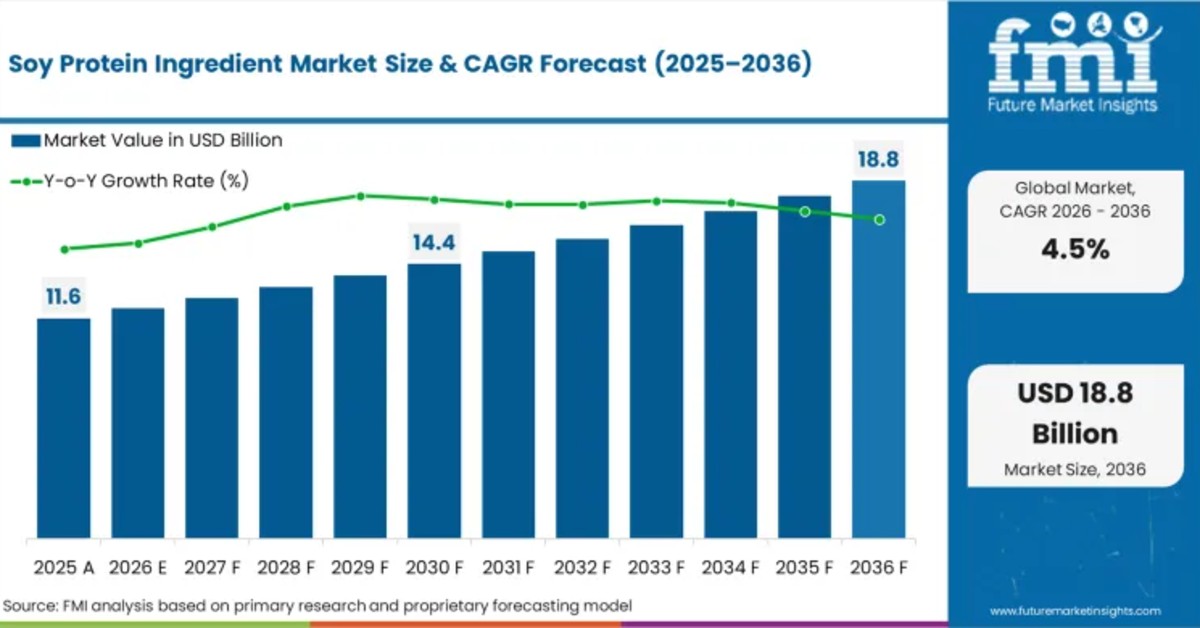
DELAWARE, NY, UNITED STATES, February 25, 2026 /EINPresswire.com/ -- The global food industry is increasingly anchoring its plant-based protein strategies around soy, leveraging its unmatched scalability and cost-performance profile. According to the latest market outlook by Future Market Insights (FMI), the global Soy Protein Ingredient Market valued at USD 12.1 billion in 2026—is projected to reach USD 18.9 billion by 2036, expanding at a steady CAGR of 4.5%.
The market is undergoing a structural shift where soy is no longer viewed merely as a commodity filler, but as a critical "compliance hedge" against volatile animal protein supply chains. With U.S. plant-based food sales reaching USD 8.1 billion in 2024, the industry is prioritizing soy for its ability to provide reliable, scalable protein inputs that novel alternatives cannot yet match at volume.
Get Access to the Full Report Sample: Explore detailed forecasts and competitive analysis. https://www.futuremarketinsights.com/reports/sample/rep-gb-628
Technical Evolution: Beyond Texturization to Functional Consistency
Agribusiness giants are repositioning soy as a natural extension of their specialty ingredient portfolios. As manufacturers rationalize formulations to protect margins, the procurement focus has shifted from simple price-per-ton to guaranteed traceability and non-GMO IP (Identity Preserved) status.
"Plant proteins are a natural extension of our industry-leading oils, fats, and specialty ingredient portfolio."
— Greg Heckman, CEO of Bunge
Manufacturers are investing in advanced texturization and enzymatic modifications to revitalize mature categories, improving mouthfeel and solubility to compete with next-generation meat and dairy alternatives.
Segment Insights: Isolates and Powder Formats Lead the Market
The market is dictated by the high-density nutritional requirements of clinical nutrition and the logistical needs of global trade.
Soy Protein Isolates (48.2% Market Share): Dominating the product segment due to their 90% protein content and neutral flavor, isolates remain the gold standard for beverage fortification and infant formula.
Powder Form (62.8% Market Share): Standardized powder remains the primary form due to its logistical efficiency, long shelf life, and ease of "drop-in" incorporation for bakery and beverage lines
Regional Dynamics: Asian Volume vs. Western Premiumization
Growth is unevenly distributed, with emerging markets serving as volume engines while mature economies focus on clean-label innovation.
China (6.1% CAGR): Leading global growth, China’s demand is fueled by massive industrial scale-up and an import engine projected to reach 106 million metric tons of soybeans by 2026.
India (5.6% CAGR): Driven by affordability and a vast vegetarian population, India is rapidly modernizing its domestic processing capabilities.
Germany (5.2% CAGR): The European leader in premiumization, where non-GMO and deforestation-free certifications command significant price premiums.
United States (3.8% CAGR): A volume-heavy baseline supported by the world's most integrated crushing and processing infrastructure.
Strategic Innovations: Clean-Label and Hybrid Systems
The next decade will see the soy industry move into "Functional Systems." Rather than selling soy in isolation, leaders are developing hybrid ingredients that combine soy with fermentation technologies. This evolution is designed to capture the "meat-plus" opportunity, where soy serves as a sustainable extender in real meat products, and the clinical nutrition sector, where specialized enzymatic proteins address the needs of aging populations.
Competitive Landscape: Capacity Rationalization and Vertical Integration
The market is characterized by a "seed-to-shelf" narrative, with top-tier players optimizing footprints to remove inefficient capacity while expanding value-added output.
Global Integrators: ADM and Bunge are consolidating production into modern, high-throughput facilities, such as Bunge’s new SPC plant in Indiana, to maintain margins in a commodity-sensitive environment.
Specialty Specialists: Companies like Fuji Oil and Sonic Biochem are focusing on application-specific solutions, such as high-purity isolates for medical and performance nutrition.
Frequently Asked Questions (FAQs)
How big is the global Soy Protein Ingredient market in 2026?
The global market for Soy Protein Ingredients is estimated to reach USD 12.1 billion in 2026.
What is the projected market value by 2036?
By 2036, the Soy Protein Ingredient market is expected to grow to approximately USD 18.9 billion.
What is the anticipated growth rate from 2026 to 2036?
The market is forecast to expand at a CAGR of 4.5% over the ten-year period.
Which product type will dominate global sales in 2026?
Soy Protein Isolates are projected to lead the market, accounting for around 48.2% of total share in 2026, supported by their superior protein concentration and broad functional applications.
How important is powder form in 2026?
The powder segment is expected to remain the preferred format, capturing nearly 62.8% of the overall market, driven by easier storage, transportation efficiency, and extended shelf life.
What is driving soy protein demand in China?
Growth in China is fueled by rapid expansion in large-scale food processing and strong demand for affordable protein fortification across multiple product categories.
Which compliance standards are highlighted for the United States?
The U.S. market references FDA-approved heart health claims and established domestic production standards as major compliance benchmarks.
What is the growth outlook for the United States?
The United States is projected to register a CAGR of 3.8% between 2026 and 2036.
Why is Europe considered a regulatory hub?
Europe plays a key role in shaping clean-label and sustainability standards, particularly regarding non-GMO certifications and deforestation-free sourcing requirements.
Why FMI: Decisions that Change Outcomes- https://www.futuremarketinsights.com/why-fmi
Explore More Related Studies Published by FMI Research:
Cat Food Market https://www.futuremarketinsights.com/reports/cat-food-market
Ginseng Market https://www.futuremarketinsights.com/reports/ginseng-market
Cultured Meat Market https://www.futuremarketinsights.com/reports/cultured-meat-market
Human Milk Oligosaccharides Market https://www.futuremarketinsights.com/reports/human-milk-oligosaccharides-market
Glutathione Market https://www.futuremarketinsights.com/reports/glutathione-market
About Future Market Insights (FMI)
Future Market Insights, Inc. (FMI) is an ESOMAR-certified, ISO 9001:2015 market research and consulting organization, trusted by Fortune 500 clients and global enterprises. With operations in the U.S., UK, India, and Dubai, FMI provides data-backed insights and strategic intelligence across 30+ industries and 1200 markets worldwide.
Contact Us:
Future Market Insights Inc.
Christiana Corporate, 200 Continental Drive,
Suite 401, Newark, Delaware – 19713, USA
T: +1-347-918-3531
Website: https://www.futuremarketinsights.com
Sudip Saha
Future Market Insights Inc.
+1 347-918-3531
email us here
Legal Disclaimer:
EIN Presswire provides this news content "as is" without warranty of any kind. We do not accept any responsibility or liability for the accuracy, content, images, videos, licenses, completeness, legality, or reliability of the information contained in this article. If you have any complaints or copyright issues related to this article, kindly contact the author above.
